
3 Low-Cap Altcoins Set to Benefit From 2026 Prediction Market Growth
Prediction markets are emerging as one of the most significant growth narratives in crypto heading into 2026. Once a niche corner of decentralized finance (DeFi), these platforms are now attracting billions in trading volume, growing institutional interest, and increasing regulatory clarity.
These conditions could significantly benefit low-cap altcoins tied to the sector’s infrastructure and marketplaces.
Low-Cap Altcoins Set to Benefit From 2026 Prediction Market GrowthBy late December 2025, prediction markets recorded more than $4.5 billion in weekly notional volume, setting a new industry record. It marked a roughly 12.5% week-on-week increase.
According to industry commentator Martins, the Kalshi prediction platform alone accounted for over $1.7 billion, representing nearly 38% of total weekly activity.
Prediction markets are here to stay.
Last week closed with over $4.5B in Total Weekly Notional Volume, setting a new record for weekly activity and surpassing the previous high by roughly $500M, an increase of approximately 12.5% WoW.
The week was led by @Kalshi, which… pic.twitter.com/4uvO8Frzhc
The surge highlights how fast prediction markets are scaling beyond their experimental roots.
This growth builds on momentum seen throughout 2025. In November, prediction markets reached a monthly trading volume of $9.5 billion, decisively surpassing meme coins and NFTs.
While meme coins generated roughly $2.4 billion and NFTs about $200 million during the same period, traders increasingly shifted toward outcome-based platforms that offer clearer utility and informational value.
From Speculation to Utility-Focused MarketsThe renewed interest in prediction markets reflects a broader shift in crypto behavior. Instead of chasing hype-driven narratives, traders are engaging with platforms that monetize forecasting across politics, sports, macroeconomics, and crypto events.
Dune data shows nearly 279,000 weekly active users, over $4 billion in weekly notional volume, and 12.67 million transactions, highlighting sustained engagement rather than short-lived speculation.
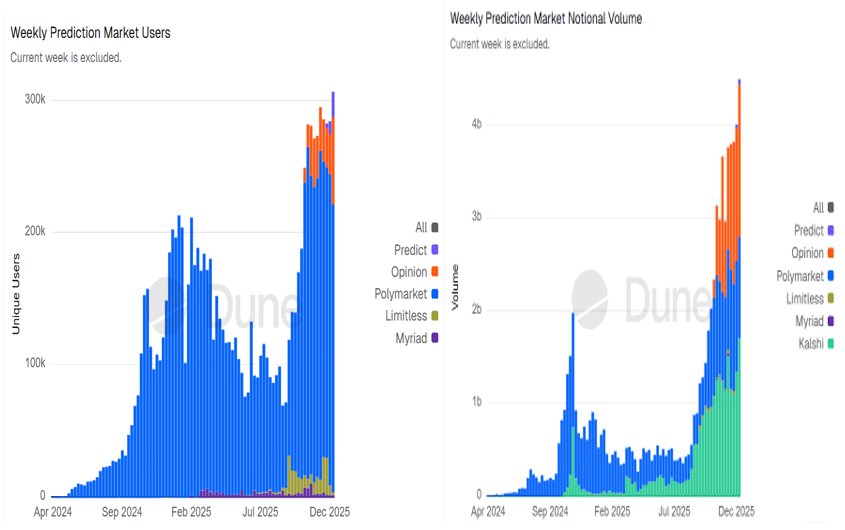 Prediction Markets’ Record High Weekly Market Users and Notional Volume. Source: Dune
Institutional momentum is also accelerating adoption. Coinbase is reportedly preparing to launch prediction markets, while Gemini’s affiliate has secured regulatory approval to offer them in the US.
Trump Media & Technology Group has also signaled plans to enter the space. Together, these moves suggest prediction markets are transitioning from fringe DeFi tools into regulated financial instruments.
As the sector grows, demand is increasing for front-end platforms as well as for reliable backend infrastructure, particularly oracles that resolve outcomes accurately. Against this backdrop, several low-cap altcoins are drawing attention.
UMAWith a market capitalization of roughly $63 million, UMA plays a foundational role in the prediction market ecosystem. It secures Polymarket, one of the leading decentralized prediction platforms.
UMA’s optimistic oracle design assumes data submissions are correct unless disputed, a model that has proven effective at scale.
According to UMA, around 99% of assertions have gone undisputed since 2021, with dispute rates declining as integrations improve.
UMA secures Polymarket.
The data shows ~99% of assertions have gone undisputed since 2021, with dispute rate continuing to fall as we make improvements to the optimistic oracle and our integration with @Polymarket.
Explore @Keyrock & @Dune’s prediction markets report