
Bitcoin’s September Crash Setting Up a Massive Q4 Breakout!

The post Bitcoin’s September Crash Setting Up a Massive Q4 Breakout! appeared first on Coinpedia Fintech News
Bitcoin has slipped back into bear mode, trading near $109,000, and once again, the “September curse” seems to be haunting the crypto market. Nearly $1.7 billion in long positions have been wiped out, shaking the confidence of retail traders.
But according to analyst CRYPTOBIRB, the bigger picture may not be about September at all, instead, Q4 could be where Bitcoin sets up for its next big breakout.
Why September Feels Like a CurseHistorically, September has never been kind to Bitcoin. CoinGlass data shows that, on average, this month has delivered 6% losses for the crypto market. Many expected 2025 to break the trend, but early gains have already been erased.
What started as one of the most promising Septembers in years has now turned flat, wiping away nearly all earlier gains.
On the other hand, it’s not just retail traders selling, institutions are pulling back too. Bitcoin spot ETFs saw four straight days of outflows, losing $1.13 billion this week, while Ethereum ETFs faced $795.8 million in outflows.
This suggests money may be shifting back into Bitcoin. For big players, fear in the market isn’t a reason to run — it’s a reason to buy.
Bear Setup, Breakout ComingDespite the panic, CRYPTOBIRB says the outlook may not be as bad as it seems. On higher timeframes, Bitcoin is still safe. But on the charts, the picture is shaky. As BTC has slipped below its 200-day trend line at $112,400, leaving $104,000 as the next key support.
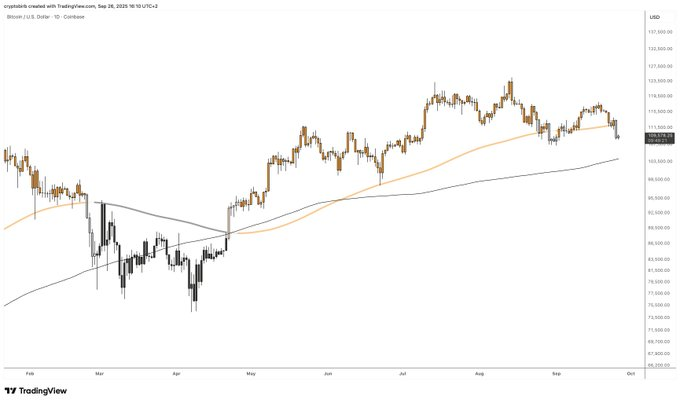
Even the momentum is fading, with RSI at 38 showing weakness. Bitcoin is stuck between $108K and $115K, hinting at a big breakout ahead.
The “Fear & Greed Index” has dropped to 33, signaling “fear,” and retail traders are panicking. Ironically, this same fear might be the fuel that sparks Bitcoin’s next major move.
.article-inside-link { margin-left: 0 !important; border: 1px solid #0052CC4D; border-left: 0; border-right: 0; padding: 10px 0; text-align: left; } .entry ul.article-inside-link li { font-size: 14px; line-height: 21px; font-weight: 600; list-style-type: none; margin-bottom: 0; display: inline-block; } .entry ul.article-inside-link li:last-child { display: none; } Q4: Bitcoin’s Strongest SeasonDespite September’s slump, CRYPTOBIRB expects Q4 to be bullish. Key drivers include potential Fed rate cuts, dollar weakness boosting risk assets, and a supply-demand imbalance, with projected institutional demand of $3 trillion against only $77 billion worth of new BTC issued annually.
History also favors the bulls. Since 2013, Bitcoin has averaged an 85% return in Q4, with November alone bringing an average 46% gain and October around 21%.
For now, Bitcoin trades at $109,590, slightly higher in the past 24 hours, but all eyes are on Q4.
Never Miss a Beat in the Crypto World!Stay ahead with breaking news, expert analysis, and real-time updates on the latest trends in Bitcoin, altcoins, DeFi, NFTs, and more.
 Subscribe to News
FAQs
What is the “September curse” for Bitcoin?
Subscribe to News
FAQs
What is the “September curse” for Bitcoin? Historically, September brings average losses of 6% for Bitcoin. This pattern of a market slump has repeated again in 2025, erasing early gains.
Is now a good time to buy Bitcoin during the fear?Market fear can signal a buying opportunity for long-term investors. The “Fear & Greed Index” is low, which has historically preceded major bullish breakouts.
What is the price prediction for Bitcoin in Q4 2025?Analysts are bullish for Q4, citing historical trends where Bitcoin averages an 85% gain. Key drivers include potential Fed rate cuts and high institutional demand.