
Is Bitcoin Price Headed Lower? Analysts Debate a Much Deeper Fall
Bitcoin fell sharply to $73,000 on February 3, extending a broader bearish trend that has now erased 41% from its October 2025 all-time high above $126,000. The drawdown has intensified debate over whether the market is approaching a cyclical bottom—or entering a deeper corrective phase.
The sell-off mirrors rising anxiety across traditional markets. US equity indices weakened amid concerns about artificial intelligence-driven disruption and escalating geopolitical risks, prompting investors to rotate away from risk assets.
In that environment, capital flowed back into traditional safe havens such as gold and silver, while Bitcoin failed to attract defensive demand.
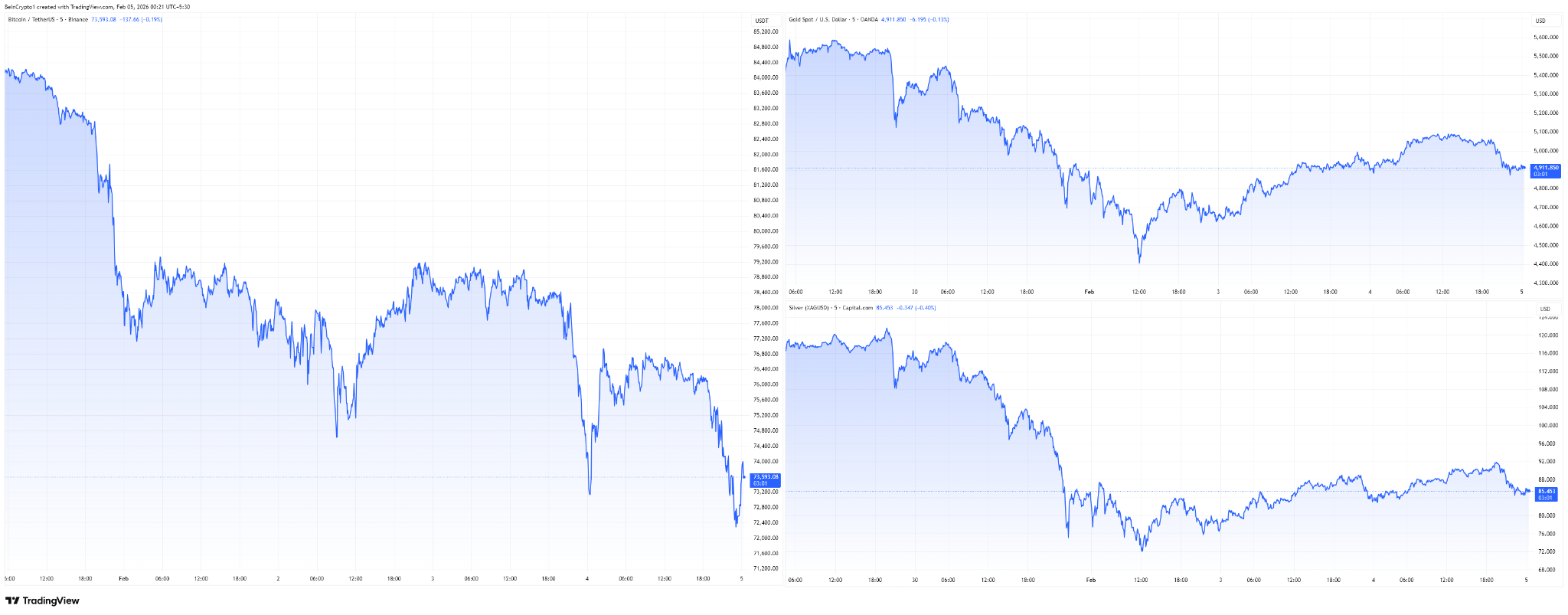 Bitcoin, Gold, and Silver 5-Day Chart. Source: TradingView
Macro and Geopolitical Stress Push Investors Toward Traditional Havens
Bitcoin, Gold, and Silver 5-Day Chart. Source: TradingView
Macro and Geopolitical Stress Push Investors Toward Traditional Havens
Bitcoin’s volatility continues to reflect macro sensitivity rather than isolation from global markets. The latest leg down coincided with renewed tensions between the United States and Iran after an Iranian drone was reportedly shot down near a US aircraft carrier.
The incident pushed the VIX up roughly 10% and drove the Crypto Fear & Greed Index into “extreme fear” territory.
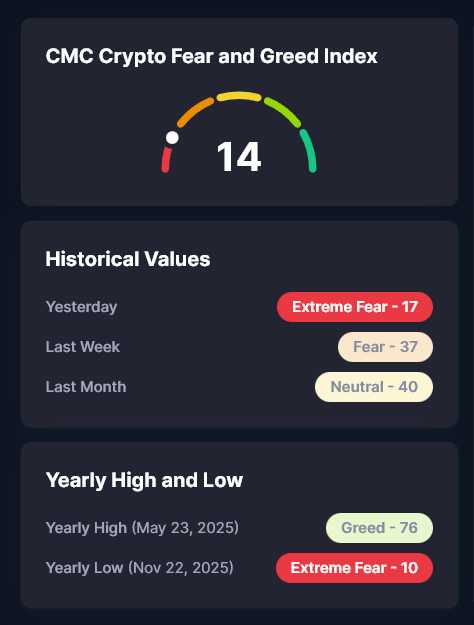 Crypto Fear and Greed Index. Source: CoinMarketCap
At the same time, developments in artificial intelligence—including new announcements around Anthropic’s Claude chatbot—sparked renewed concerns about disruption across the tech sector.
That uncertainty weighed on major technology stocks and further reduced appetite for speculative assets.
While Bitcoin declined, gold rose 6.8% and silver gained 10%, reinforcing their role as preferred hedges during periods of monetary and geopolitical stress.
Speaking to CNN, Gerry O’Shea, Global Head of Market Insights at Hashdex, noted that the divergence between Bitcoin and gold suggests investors still view precious metals as the primary safe haven during periods of uncertainty.
That shift has weakened Bitcoin’s short-term refuge narrative and added downside pressure.
Fun fact: Gold's correlation with Bitcoin over the last 10 years is 0.09.
In other words, they are not correlated at all, and do not move together. We have seen this movie before. The last time was COVID.
Patience, fellow Bitcoiners. pic.twitter.com/yBcSJVrS2U
Market participants remain divided, but several analysts are openly warning that the correction may not be over.
Crypto analyst Benjamin Cowen argued that Bitcoin’s near-term path is critical:
*#BTC just dropped below the April 2025 low.*
If it does not bounce soon, this is going to be one hell of a midterm year.
If it can bounce, it gives us a few months and gets us closer to October without so much bad price action (likely the bottom in time).
I feel like the bear… pic.twitter.com/5avv8DKNjG
Other analysts are more pessimistic. Nehal, a widely followed trader on X, suggested the current structure resembles a classic bull trap, warning that the move lower may only be halfway complete.
According to Nehal’s historical comparison, Bitcoin’s previous cycles ended with drawdowns of 86% in 2018 and 78% in 2021.
Applying a similar framework to the current cycle implies a potential 72% decline, which would place Bitcoin near $35,000.
This cyclical perspective remains influential despite structural changes in the market, including ETF adoption and greater institutional participation.
This chart says we’re only halfway through the Bull Trap.
If the pattern is still in play, $BTC will dump to $35,000 in February.
The bear market hasn’t even started yet. pic.twitter.com/Igdx4uQuzQ
On-chain indicators are adding another layer to the debate. Analyst CryptOpus noted that Bitcoin has entered what he describes as a “bottom discovery” phase for the first time this cycle.
At the 2025 peak, roughly 19.8 million BTC were held in profit. That figure has now dropped to 11.1 million BTC, a 40% reduction in profitable supply.
Historically, similar conditions have marked transitions from corrective phases toward cycle resets. In 2018, Bitcoin remained in this state for roughly eight months before stabilizing.