
How to Choose the Right Decentralized Exchange Development Company in 2026
 Projected growth of the decentralized finance (DeFi) market from 2024 to 2030
Decentralized exchanges aren’t just a side project anymore. Fast forward to 2026, and DEX trading volumes are going toe-to-toe with traditional centralized platforms. Companies across gaming, fintech, and DeFi are rushing to build their own trading hubs.
But there is a massive elephant in the room: your DEX will only be as strong as the engineers who code it.
Picking the wrong decentralized exchange development company will lead to endless delays, security flaws, and heavy financial losses. But the right team? They turn into your ultimate business advantage.
This guide explains what to watch out for, what to dodge, and how to confidently select a decentralized exchange development company in 2026.
Why Businesses Are Investing in Decentralized Exchange DevelopmentLet’s tackle the main question first — why is everyone jumping in now?
DeFi hasn’t lost its momentum; it just grew up. The Total Value Locked (TVL) in DeFi protocols keeps climbing. Even traditional institutions that used to ignore blockchain trading are jumping on board.
Here is the real reason why brands are pushing hard into decentralized exchange development this year:
• Peer-to-peer trading is booming.
People want to manage their own money without trusting a middleman. DEX platforms solve this perfectly.
• Better security.
Since DEXs do not hold user money, they remove the central target that hackers usually attack. This prevents the billion-dollar hacks we’ve seen in the past.
• Total transparency.
Every single trade on a DEX shows up on the blockchain. This gives businesses a clear, trust-free setup that today’s users demand.
• Strong profits.
Trading fees, liquidity rewards, and new token listings give DEX owners clear ways to make money.
For both startups and massive corporations, dex development is no longer just a cool concept; it is a core business move.
What Does a Decentralized Exchange Development Company Do?Before you start interviewing teams, you need to know what you are actually paying for.
A top-tier decentralized exchange development company does a lot more than just write scripts. They build an entire financial machine. Here is a look at their main dex development services:
Smart Contract DevelopmentThis is the heart of your platform. Smart contracts run every trade, fee, and liquidity update automatically. If these contracts are weak, hackers will exploit them. Getting this right is mandatory.
UI/UX DesignIf your DEX is hard to use, traders will leave immediately. Great teams design screens that feel as easy as everyday apps, while running completely on decentralized tech.
Liquidity Pool IntegrationA trading platform without money in it is useless. Expert developers connect AMM protocols and liquidity reward systems from the very beginning.
Security AuditsBefore you go live, experts must check every single line of code. Trustworthy teams do their own strict testing or hire outside auditors like Hacken or CertiK.
Blockchain IntegrationWhether you want to launch on Solana, Ethereum, BNB Chain, or across multiple networks, your team must have deep, proven experience connecting to different blockchains.
The smartest teams don’t just hand over a basic app. They give you a platform that can grow safely, stay secure, and adapt to future changes.
10 Factors to Consider When Choosing a Decentralized Exchange Development CompanyThis is exactly where many business owners fail. They look for the cheapest price or the fastest delivery, completely missing the details that actually matter.
Here are the 10 core factors you must check:
1. Blockchain ExpertiseNot all networks work the same way, and not all coding teams know every network. Ask them point-blank about their past work on Polygon, Solana, BNB Chain, Avalanche, and Ethereum. Knowing how to build across multiple chains is a massive bonus in 2026.
2. Smart Contract Development SkillsThis is the most important technical requirement. Demand to see the smart contracts they have built before. Question them on how they test their code. Check if they use trusted templates like OpenZeppelin. Poor smart contract skills lead directly to stolen funds.
3. Security and Auditing StandardsAsk the decentralized exchange development company if they have dedicated security experts on staff. Do they force a third-party audit before launch? Have their past projects survived real hacking attempts? Security is the main pillar of your platform, not an add-on.
4. Custom Development CapabilitiesPre-made, white-label DEX templates are cheap and quick to launch. But they are also generic. If you need unique token rules, special trading pairs, or custom fees, you need a team that builds from the ground up, not one that just changes the logo on a template.
5. Liquidity Management SolutionsA DEX without active traders is dead. Ask the team how they plan to bring in initial liquidity. Have they built liquidity mining features before? Do they know how to link your DEX to larger cross-protocol liquidity networks?
6. UI/UX Design QualityCheck their past projects carefully. Could a beginner figure out how to trade on their platforms? Today, a great user experience wins the market. Confusing layouts push users right to your rivals.
7. Cross-Chain IntegrationBuilding on just one blockchain limits your audience. The absolute best dex development company knows exactly how to build cross-chain bridges and multi-chain wallets. If they struggle to explain this, walk away.
8. Development TimelineDo not trust teams that promise to build a flawless DEX in just a few weeks. A highly secure, ready-to-launch exchange takes real time. A reliable company will give you a step-by-step schedule with clear goals, instead of tossing out fake, rushed deadlines.
9. Cost TransparencyThe price to build a DEX jumps around a lot. It can range from $30,000 for a basic copy-paste setup to well over $200,000 for a massive custom project. The final number isn’t the only thing that matters — what matters is seeing exactly where every dollar goes. Hidden fees always pop up later if the project plan isn’t crystal clear at the start.
10. Post-Launch SupportThe day you launch is just the beginning. Bugs will happen. You will need upgrades. A highly professional decentralized exchange development company gives you an actual support plan for the months after launch, not just a generic support ticket system that nobody checks.
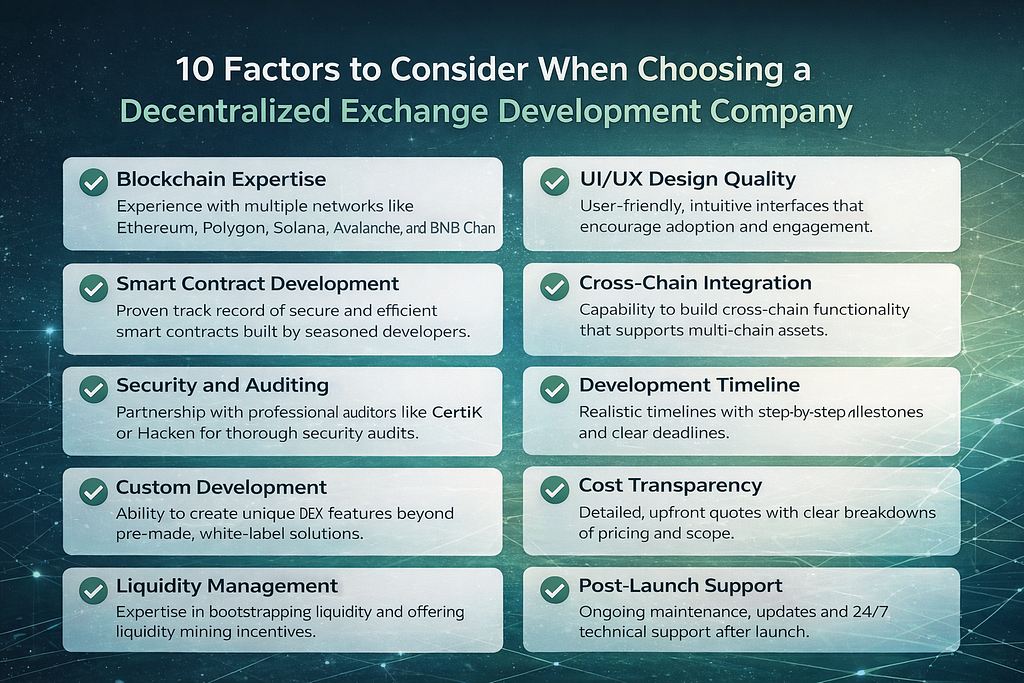 Key factors businesses should evaluate when selecting a decentralized exchange development company.Key Technologies Used by a Professional DEX Development Company
Knowing the tech terms helps you ask the right questions — and helps you spot agencies that try to cut corners.
Solidity is still the top programming language for Ethereum and similar networks. Any reliable team must be experts in it.
AMM Protocols — Automated Market Makers (like the tech behind Uniswap) power most DEX platforms today. True experts understand complex math like constant product formulas and dynamic fees. Mediocre developers don’t.
Smart Contract Frameworks — Tools like Truffle, Hardhat, and Foundry are the gold standard for writing and testing code. A team using these tools shows they take professional decentralized exchange development seriously.
Blockchain Infrastructure — Fast data connections, node setups, and indexing tools (like The Graph) keep your exchange running smoothly even when thousands of people trade at once.
Liquidity Pool Architecture — Things like single-sided pools and concentrated liquidity are highly advanced concepts. A premium blockchain development company will know how to build these perfectly, not just copy them.
Cost of Hiring a Decentralized Exchange Development CompanyLet’s discuss pricing directly, because knowing the budget saves everyone from wasting time.
In 2026, the price of building a DEX comes down to four major variables:
• Blockchain Choice — Standard networks (like Polygon or Ethereum) are usually faster and cheaper to build on. Unique networks like Solana need special skills, which naturally cost more.
• Feature Set — A simple token swapper is cheap. A massive platform with limit orders, user voting, and cross-chain tracking will cost a lot more.
• Security Requirements — Top-tier code audits are expensive. But skipping them will cost you far more when a hacker finds a weak spot.
• Custom vs. White-Label — Basic, pre-made platforms cost between $30K and $60K. A good custom build usually sits between $80K and $150K. Massive, feature-heavy enterprise exchanges start around $150K and go up from there.
Whenever a decentralized exchange development company gives you a quote, demand a line-by-line breakdown. If they give you a cheap price but no details, that is a massive warning sign.
Benefits of Hiring an Experienced DEX Development CompanyExperience is not just a fancy word on a website — it directly changes your final product.
• Faster, safer launch. Veteran teams have already built and fixed these systems. They stop problems before those problems become expensive.
• Security assurance. Teams that have safely launched multiple platforms know exactly how hackers think. You cannot fake that kind of institutional knowledge.
• Scalable architecture. A platform made for 100 people will completely break if 100,000 people show up. A top-tier dex development company builds your code to handle massive scale from day one.
• DeFi ecosystem expertise. Connecting to other liquidity networks, bridges, and yield setups requires deep industry knowledge, not just coding ability. Experienced partners bring their own network and strategies to the table.
When you handle decentralized exchange development the right way, it protects your business from competitors. It becomes a moat, not just a product launch.
The Future of Decentralized Exchange Development in 2026The DEX space moves incredibly fast. Here is what is driving the market right now:
• Cross-Chain DEXs are becoming the normal standard. Platforms that allow users to easily trade tokens across entirely different networks without friction are winning the market.
• AI-Powered Trading Integrations are stepping in. From smart trade routing to scanning the blockchain for market moods, AI is changing how liquidity works. You need to build your DEX with AI compatibility in mind.
• Advanced Liquidity Models — Features like concentrated liquidity and pools tied to real-world assets (RWAs) are pushing DEX innovation way beyond basic token swapping.
• Institutional Adoption is moving fast. DEX setups with optional KYC rules and permissioned pools are finally bringing massive corporate money into the DeFi space.
The agencies building the right tech today will be the platforms handling all this institutional cash tomorrow.
Ready to Build Your DEX Platform?Picking your tech partner is the single biggest choice you will make for your exchange.
The ideal decentralized exchange development company gives you deep technical skills, strict security habits, and a long-term partnership focus. Whether you are a startup launching your first DeFi product or a massive enterprise building secure infrastructure, the line between good and great comes down to who types the code.
Final ThoughtsIn 2026, the market only rewards DEX platforms that are built with precision. Smart architecture, huge scalability, and unbreakable security are not optional extras; they are the bare minimum.
Picking the right decentralized exchange development company is a major strategic move, not just a quick shopping trip. Take your time. Ask the hard questions. Look at their live products instead of just reading their presentation slides.
Build it right. Build it once.
If you are looking for a team that prioritizes security, scalability, and clean architecture, we should talk.