How to Create ERC-20 Tokens on 35+ Blockchains Without Coding (2025 Guide)
 DAOs in practiceDAOs in Practice — From Multi-Sig to Voting (And Why Ownership Tokens exist)The Question Every DAO Asks
You just learned how DAOs work(Day 16). You know about voting, governance tokens, and treasury management. But here’s the uncomfortable truth: Most people in crypto have never actually participated in a real DAO.
Today, we fix that. You’re going to:
- Set up a Multi-Sig wallet (how DAOs actually control their money)
- Cast a real governance vote (how DAOs actually make decisions)
- Understand why the model is already evolving
By the end of this, you won’t just understand DAOs. You’ll have proof that you’ve used them. And you’ll know what comes next.
This is Day 18 of my 60-Day Web3 Journey. Yesterday (Day 17), I broke down Stablecoins — the economic backbone that DAOs use.
Join the Community!
Follow: Medium | Twitter
The Problem:
If a DAO has $100 million in its wallet protected by a single private key, one person can steal it all. Even if that person is “trusted,” one leaked key = game over.
The Solution:
Multi-Sig wallets require N-of-M approvals. For example, a 3-of-5 multi-sig means:
- 5 people hold keys
- Any 3 of them must approve a transaction
- No single person can steal the funds
Step 0: Create Your Burner Wallets
Before we set up the Safe, you need 3 wallet addresses. You’ll use your main wallet + two burner (test) wallets.
- Open MetaMask (your browser extension)
- Click the account icon (top right corner, where it shows your current account name)
- Click “Create account”
- Name it: “Burner #1”
- MetaMask creates it automatically with a new address
- Repeat: Click account icon → “Create account” → Name it “Burner #2”
Now you have 3 accounts in MetaMask:
- Account 1 (your main wallet)
- Burner #1
- Burner #2

Get your 3 addresses:
- Click on each account
- Click the address to copy it
- You now have 3 addresses ready for the Safe
Step 1: Go to Safe
- Go to: https://app.safe.global/
- Connect: Your main wallet (MetaMask)
- Choose Network: Sepolia Testnet (dropdown at top)
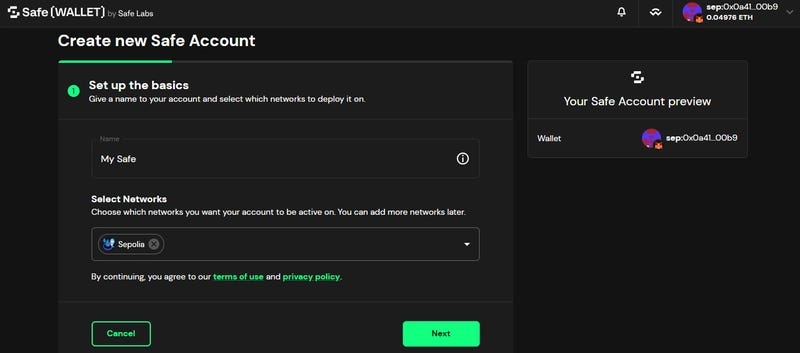
Step 2: Create Your Safe
- Click “Create new Safe”
- Name it: “DAO Treasury (Test)”
- Network: Confirm Sepolia is selected
- Click “Create”
Step 3: Add Owners
- Add owner 1: Paste your main wallet address
- Add owner 2: Paste your Burner #1 address
- Add owner 3: Paste your Burner #2 address
- Set threshold: 2-of-3 (meaning 2 out of 3 must approve any transaction)
- Review and confirm
 Signers
Step 4: Fund Your Safe
- Safe is created → You get a Safe address
- Send testnet ETH to it: Send 0.1 testnet ETH to your Safe address
- Switch to your main wallet in MetaMask
- Send 0.1 ETH to the Safe address
3. Wait for confirmation (~15 seconds on Sepolia)
Step 5: Execute a Multi-Sig Transaction
- In Safe dashboard: Click “New transaction”
- Send 0.01 ETH to any address (could be your main wallet)
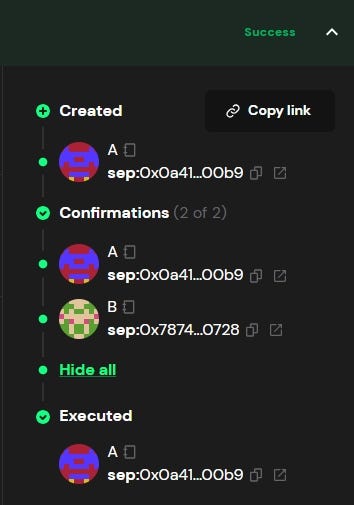
- Click “Create” → Transaction is initiated but NOT executed
Owner #1 (you) approves: Click “Approve”

Owner #2 approval needed:
- Switch to Burner #1 in MetaMask
- Go back to Safe (it recognizes your new account)
- Find the pending transaction
- Click “Approve”
Transaction executes: Once 2-of-3 approve, the transaction automatically sends
 Transaction Successful
What You’ve Just Learned:
- How DAOs actually secure billions in assets
- The difference between “signing” and “executing”
- Why DAOs can’t be hacked by one person
- How permissions work in decentralized systems
- Why no single treasury manager can go rogue
The Problem:
In traditional organizations, the CEO makes decisions. In DAOs, the community makes decisions. But how do you vote on a blockchain when gas fees cost $50?
The Solution:
Off-chain voting on Snapshot (free, gasless) or On-chain voting on Tally (costs gas, but immutable). Most DAOs use Snapshot for proposal discussion and Tally for binding votes.
- Go to: https://snapshot.org/
- Connect: Your main wallet (MetaMask)
- Find a DAO to vote on: Search for:
- “Uniswap” (largest protocol)
- “Aave” (DeFi governance)
- “Optimism” (Layer 2 governance) Note: While doing so these 3 had no active proposals so I selected Magic DAO.
Browse Active Proposals: Look for ones with “Voting” status
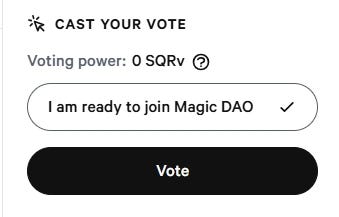
Cast Your Vote:
- Click “Vote”
- Choose your position (For/Against/Abstain)
- Submit (it’s gasless, so it’s free!)
Check the Results: See how your vote compares to the community
 Voting
What You’ve Just Learned:
- How governance actually happens on-chain
- The difference between signal voting (Snapshot) and binding votes (Tally)
- Why large DAOs use multi-step governance (discussion → signal → execution)
- That you are now officially part of a decentralized organization
You just voted on Snapshot. Congratulations. But here’s the uncomfortable truth: 90% of token holders never vote. They just hold and speculate on price.
Most DAOs aren’t actually decentralized. They’re controlled by the same 5 people who bother to show up to votes.
Why? Because governance tokens have a flaw: They give you voting power, but not financial incentive to use it.
The Shift: Governance → OwnershipOld Model (Still Dominant):
- Hold UNI → You can vote on Uniswap proposals
- Problem: 90% of token holders never vote. They’re just speculating on price.
- Result: Governance becomes theater. “Decentralized” but actually controlled by whales who bother to vote.
New Model (Emerging):
- Hold token → You get voting rights + financial returns (protocol fees, revenue share)
- Alignment: If the protocol succeeds, YOU benefit financially. You’re incentivized to vote well.
Curve (CRV): Started as pure governance but now includes yield farming rewards.
Optimism (OP): Added revenue-sharing for token holders (not just governance rights).
Arbitrum (ARB): Designed with ownership economics from day one — voting matters because your vote affects your returns.
Uniswap (UNI): Moving toward protocol fee distribution to token holders.
The Real Future of DAOsGovernance tokens aren’t dead. But they’re evolving.
The future looks like: Tokens that align incentives. You vote because your vote directly affects your financial returns. Not because you feel idealistic about decentralization.
When the incentives align, two things happen:
- More people actually participate in governance
- Better decisions get made (because voting matters financially)
That’s when DAOs actually work.
Part 4: Connecting the Dots — Why These Two Are LinkedThe Real DAO Flow:
- Snapshot Vote → “Should the DAO send 10 ETH to fund the marketing team?”
- Vote passes → 60% in favor
- Multi-Sig owners execute → 2-of-3 approve the transaction
- Treasury sends 10 ETH → Marketing team receives funds
Without multi-sigs, a single governance coordinator could take the vote results and send the money to their own wallet. Multi-sigs prevent this.
Without governance voting, a single person (the “DAO founder”) decides where all the money goes. Voting prevents this.
And increasingly, without ownership incentives baked into the token, most people won’t bother voting at all. Aligned incentives change that.
Together, they create the “checks and balances” that make DAOs actually decentralized.
My Learning JourneyI always wondered: “How do communities actually vote on decisions?”
In Web2, it’s:
- Slack poll (not binding)
- Confluence docs (usually ignored)
- Meeting where the loudest voice wins
In Web3, it’s different. A DAO vote is immutable, timestamped, and visible forever. You can’t fake participation. You can’t claim “the community wanted X” when the vote says Y.
That’s powerful. But I realized something else: Most DAOs today are just “governance theater.” The voting exists, but most people don’t participate.
The exciting part? The space is evolving. Projects are moving from “governance tokens” to “ownership tokens” — where your vote actually affects your financial returns. That changes everything.
That’s the future. And now I’ve actually participated in both models.
Resources to Go Deeper:- Safe Docs — How to manage multi-sigs across chains
- Snapshot Docs — Building governance into your DAO
- Tally Governance — On-chain voting with binding execution
- The Future of Tokenomics — How token design actually matters (Day 12 revisited)
DAOs in Practice — From Multi-Sig to Voting (And Why Ownership Tokens exist) was originally published in Coinmonks on Medium, where people are continuing the conversation by highlighting and responding to this story.