
Leap Seconds & Time in Solidity
RWA (Real World Assets) isn’t a new concept in Web3.
As early as 2019, MakerDAO had already started incorporating certain real‑world assets, such as real estate‑backed debt, into the collateral framework of its stablecoin DAI. At the time, however, these efforts were largely limited to small‑scale experiments and had yet to gain mainstream recognition.
Fast forward to 2024, the landscape looks very different. With major traditional financial institutions entering the space, particularly on Wall Street, RWA has evolved from a niche technological sandbox into a high‑stakes battleground, drawing the attention of global capital and regulatory bodies alike.
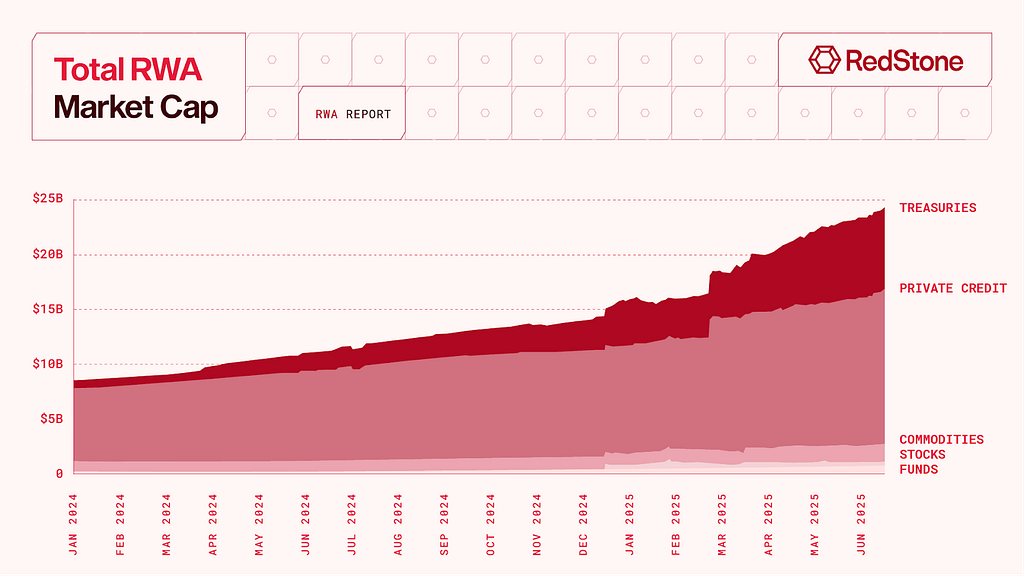
According to Redstone’s latest report, “Real-World Assets in Onchain Finance”, the RWA market has grown dramatically. As of June 2025, the total size of RWAs has surged past $24 billion, up from just $5 billion in 2022, a staggering 380% increase. This growth positions RWAs as the second most significant source of on-chain liquidity after stablecoins. The report also gives a prediction that by 2034, as much as 30% of global assets (worth over $400 trillion) could be tokenized and brought on-chain.
Yet when we ask the question, “What actually qualifies as an RWA?”, the market’s mainstream answers remain concentrated on two familiar categories:
- Tangible assets with physical carriers, such as real estate, fine art, and carbon credits;
- Standardized financial instruments, including treasury bonds and money market funds.
But outside of these categories, another asset class is quietly entering the conversation: digital assets — and, more specifically, data.
As data’s role becomes increasingly critical across AI training, digital advertising, and on-chain economies, its value is shifting. Data is no longer just a passive byproduct; it is emerging as a new factor of production and increasingly exhibits key RWA-like attributes: it is real, verifiable, and tradable. This evolution has led more and more market participants to envision data as part of the broader “on-chain asset” landscape.
This brings us to the central question:
Can data truly qualify as an RWA? And if so, what redefinitions and frameworks are required to make this possible?
This article explores these questions by analyzing two emerging pathways for data assetization. We’ll examine their underlying foundations, architectural designs, and value distribution models, and explain how data may gradually gain recognition as a “real-world asset” within the broader RWA framework.
Path 1: The RDA ModelThe reason RWAs (Real World Assets) can “go on-chain” is not because the physical assets themselves are moved onto the blockchain. Instead, the key lies in digitizing, standardizing, and verifying the value flows and ownership structures behind these assets.
What actually circulates on-chain is not a piece of land or a piece of equipment, but the rights and income claims associated with it. These claims are secured by sustainable operational data and trusted rights-verification mechanisms.
For example, consider LongXin’s EV charging stations. What gets tokenized is not an isolated physical device, but a complete data asset that combines the equipment and its operational data. The on-chain token includes metrics such as historical electricity consumption, yield rates, and device status, and these data points form the foundation for pricing, valuation, and profit distribution. In other words, the asset’s core value is derived from its operational data system, not from the physical hardware itself.
This naturally leads to a bigger question: If the core value of these assets lies in their data, could the data itself be directly issued and traded within an RWA-like framework?
In July 2025, the Shanghai Data Exchange introduced a new paradigm called RDA (Real Data Assets) during a closed-door seminar. The goal is to incorporate verifiable, measurable, and tradable data assets into RWA-inspired structural designs, paving the way for a market-driven approach to data assetization.
Taking the Shanghai Data Exchange’s pilot projects in agricultural logistics and industrial equipment data as examples, its basic operational path is as follows:
- Data rights confirmation and encapsulation: Data sources are provided by equipment manufacturers, industry leaders, or local governments, and then packaged by dedicated rights-certification institutions together with trusted execution environments (TEE).
- Structuring and pricing: Technical service providers and valuation agencies determine the pricing of data assets and design revenue models.
- Issuance and trading of rights: Financial institutions carry out issuance and market-making, allowing investors to subscribe to the corresponding income-right certificates.
From the perspective of underlying architecture and value distribution design, the RDA pathway remains closely aligned with traditional RWA. What circulates on-chain are data packages anchored to real-world resources, and the underlying logic is still:”Data creates the asset, the asset secures the revenue”. In this model, data merely serves as the representational layer within the RWA framework, with its fundamental role still tied to financing.
However, precisely because it extends the traditional RWA logic, data asset issuance under the current RDA framework still faces three structural limitations:
Absence of Data ContributorsCurrently, RDA assets are primarily uploaded by platforms or institutions, while the original data producers, such as software users and consumers, are not included in the issuance structure. This creates a natural disconnect between data ownership and data usage rights, making user-driven rights confirmation and authorization nearly impossible.
Lack of Incentive MechanismsUnder the current RDA pathway, although data is mapped and circulated on-chain as an asset, its role is largely confined to being a financing tool. Returns are typically distributed to token purchasers through contracts or agreements, remaining decoupled from the actual process of data generation. The incentive model resembles a closed loop of capital in → returns out, rather than a cycle of data supplied → revenue shared.
Lack of Usage and Validation PathwaysWithin the RDA framework, data is packaged as an asset class and serves primarily as the basis for valuation and financing, rather than being directed toward real usage scenarios such as analytics, modeling, or AI applications. Circulation largely remains confined to token transfers, with the underlying data never engaged in downstream applications. As a result, it is difficult to build a dynamic feedback mechanism, leaving no room for value re-validation or iterative updates. This also undermines the possibility of “secondary pricing based on performance in use”, which in essence contradicts the fundamental expectation of data as an evaluable and verifiable asset.
These limitations indicate that while the RDA pathway brings data closer to the form of on-chain assets from a technical standpoint, its foundation still reflects the old paradigm of “data serving finance”. It has yet to establish a true closed loop of incentives, rights confirmation, and usage centered on data. Breaking beyond these limits requires a different approach, and this is where the DataFi model comes in.
Path 2: The DataFi ModelUnlike RDA’s “asset–financing–dividend” logic, DataFi does not treat data itself as collateral for asset issuance. Instead, it converts user-generated behavioral data, produced on-chain or within platforms, into structured, verifiable data units protected by cryptography, with clear usage boundaries.
These data assets can circulate in data marketplaces, or be purchased and validated by brands and platforms in their operations, breaking away from the single token-centric model.
More importantly, DataFi establishes a lightweight circulation model built on user-led authorization paired with platform-driven demand matching, enabling multi-party participation and sustainable operations.
At present, DataFi remains in the early stages of development. While the underlying cryptographic technologies, such as smart contracts, zero-knowledge proofs (ZK), multi-party computation (MPC), and trusted execution environments (TEE), are relatively mature, realizing controllable data circulation still requires extensive refinement across multiple dimensions:
- How to build a sustainable mechanism for matching data supply with demand;
- How to standardize and lower the barrier of interaction between users and brands;
- How to create a genuine incentive loop without relying on speculative expectations.
DataDanceChain (DDC) is attempting to fill these structural gaps through its own architecture. Although the product has not yet been fully launched, the DDC team has already conducted technical validations with several brands and data demand partners, establishing an initial closed loop: structured data generation, user authorization, privacy-preserving validation, and commercial feedback.
Building on this foundation, DDC is developing a new product pathway centered on “data usage entry points”, designed to provide lightweight sharing mechanisms suitable for both Web2 and Web3 users. This allows individuals to participate in structured data generation and revenue sharing with lower barriers to entry and clearer authorization boundaries.
From DDC’s design principles, three core advantages of the DataFi model become evident:
User-Centric Control of Data OwnershipIn traditional Web2 or RDA-style data models, ownership of data is typically held by platforms or asset issuers. While individual users may serve as data providers, they have little ability to define how their data is used or how the resulting value is distributed.
DataFi, by contrast, restores the asset boundaries of data to the users themselves through structured behavioral data + user-led authorization:
- Users can decide whether to authorize their behavioral data, to whom, and for what purposes;
- Authorizations can be time-bound and usage-limited, preventing one-off buyouts or misuse;
- Rewards generated from data are returned directly to the contributing user.
The second major advantage of DataFi lies in its ability to achieve both verifiability and privacy protection in the data transaction process.
Traditional data markets often face a trade-off: either sacrificing privacy for usability (as in Web2 advertising, where full-chain data capture and tagging are common), or imposing such strong privacy constraints that transaction efficiency is severely limited.
DataFi addresses this by adopting a composite cryptographic architecture — centered on ZK proofs, TEEs, and MPC, alongside a sub-address identity model for on-chain interactions. Together, these elements create a “verifiable yet non-reversible” structure for data asset transactions:
- Data is structured and labeled locally by the user; platforms only receive proofs of validity, never the raw data itself.
- Verification is executed via ZK or MPC, requiring no intermediaries, decryption, or human intervention.
- Behavioral identifiers are decoupled from main identities through sub-addresses and similar mechanisms, ensuring non-traceability.
This mechanism is not limited to commercial data transactions. It is also being applied in contexts such as AI training data contributions and public research data donations. For example, in the case of AI agents, users can define the scope and destination of their training data, while platforms provide de-identified verification and incentive distribution, ensuring users can participate in AI without exposing themselves.
Sustainable Incentives and Real-Time Feedback MechanismsUnlike RDA’s one-off issuance model for returns, DataFi introduces a dynamic incentive structure built on “participation equals feedback, usage equals rewards”.
- Uploading data earns points, tokens, or upfront incentives;
- When behavioral data is matched and used, contributors receive secondary rewards;
- Long-term contributors can accumulate additional value, such as membership benefits or governance rights.
Crucially, DataFi’s incentive design does not rely on speculative price expectations. Instead, rewards are determined by the degree of commercial relevance and usage of the data itself. This logic is closer to the familiar Web2 path of “participation → usage → return”, but grounded in privacy protection and verifiable value.
Under this architecture, data assetization no longer depends on collateralization, external valuation, or custodial issuance. Instead, it is built on the structured usability of data itself. The DataFi pathway does not aim to turn data into a speculative commodity with arbitrary pricing. Rather, it transforms data into circulable, incentivized, and controllable units of value, establishing a model of asset formation grounded in genuine interaction and usage.
Two Paths, One Common QuestionFrom RDA to DataFi, the approaches may look different on the surface, but both are ultimately answering the same question: on what basis can data truly become an asset?
Is it through rights registration, or through proof of usage? Is it meant for collateralized financing, or for circulating transactions? Does it remain a static stock controlled by platforms, or is it a stream of dynamic, high-frequency intent generated by users?
There may be no single definitive answer, but the trend is becoming clear: the essence of data assetization lies not in who owns the data, but in how the data is used.
Only data that is verifiable, usable, bounded, and capable of delivering clear feedback can truly take on asset-like properties. Whether it is RDA’s financialized mapping or DataFi’s structured circulation, the real competition at the foundation is over which usage mechanism best aligns with the nature of data itself.
Whoever manages to establish consensus and network effects around such a mechanism may well define the next stage of data as an asset.
About DataDanceChainDataDance is a consumer chain built for personal data assets. It enables AI to utilize user data while ensuring the privacy of that data.
DataDance caters to both individual users and commercial organizations (brands). Through the DataDance Key Derivation Protocol, the network’s nodes achieve multi-layered privacy protection while being EVM-compatible. This ensures absolute data privacy while enabling rights management, data exchange, asset airdrops, and claims.
Website: https://datadance.ai/
X (Twitter): https://x.com/DataDanceChain
Telegram: https://t.me/datadancechain
GitHub: https://github.com/DataDanceChain
GitBook: https://datadance.gitbook.io/ddc
DDC Insights: From RWA to DataFi, How Can Data Truly Become an Asset “Everyone Can Hold”? was originally published in Coinmonks on Medium, where people are continuing the conversation by highlighting and responding to this story.