
US GDP Surprise Signals Trouble for Altcoins, Not Bitcoin
The latest US GDP report delivered a strong economic signal—but for crypto markets, especially altcoins, it may be bad news.
Data released on December 23 showed the US economy growing faster than expected in Q3, reinforcing the idea that monetary conditions may stay tighter for longer. While Bitcoin remains relatively resilient, broader crypto markets are flashing warning signs.
US GDP Growth Beats ExpectationsThe US economy expanded at an annualized rate of 4.3% in Q3, well above the market forecast of 3.3% and higher than the previous 3.8% reading.
The year of the tariff is powering America’s economy as real GDP accelerated to a 4.3% annualized rate and exports rose to an 8.8% SAAR in the third quarter.
This is just the beginning of new era of economic prosperity thanks to President Trump’s trade program unlocking new… pic.twitter.com/kWeBtxQ7aN
At the same time, core PCE inflation rose to 2.9%, up from 2.6%, remaining sticky above the Federal Reserve’s 2% target.
Also, Real personal consumption expenditures jumped 3.5%, far exceeding expectations of 2.7%.
In simple terms, Americans are still spending aggressively, and inflation pressures have not cooled enough for policymakers to declare victory.
Why Strong Growth Is a Problem for CryptoStronger-than-expected growth reduces the urgency for interest-rate cuts.
Combined with recent CPI data and still-elevated inflation expectations from the University of Michigan survey, the GDP report strengthens the case for higher-for-longer rates in 2026.
For risk assets like crypto, that matters because:
- Higher rates increase the return on cash and bonds.
- Liquidity becomes more selective.
- Speculative assets struggle to attract new capital.
This environment historically pressures altcoins more than Bitcoin.
The US economy has now been in an expansion for 65 months with annualized real GDP growth of 4.3% over that time.
The average expansion length since 1949: 67 months.
Longest: 128 months.
Shortest: 12 months. pic.twitter.com/QE6WnhhMA5
Market reaction following the GDP release reflected this dynamic.
Bitcoin remained relatively stable near $87,800, down modestly on the day but still holding key structural levels. Its market cap stayed above $1.75 trillion, showing limited panic selling.
Altcoins, however, underperformed sharply:
- Ethereum fell over 3% on the day.
- Solana, Cardano, and Dogecoin dropped between 3%–6%.
- Mid-cap and small-cap tokens saw deeper losses with weaker recoveries.
This divergence highlights Bitcoin’s role as a liquidity sink during macro uncertainty.
Crypto MACD Confirms Bearish BreadthMomentum indicators reinforce the concern.
According to CoinMarketCap’s normalized MACD, 68% of tracked crypto assets are now in negative momentum. The average market MACD sits at –0.16, firmly in bearish territory.
Most assets below the $10 billion market-cap range remain deeply negative.
When momentum weakens across the market, capital tends to retreat toward fewer, more liquid assets—again favoring Bitcoin over altcoins.
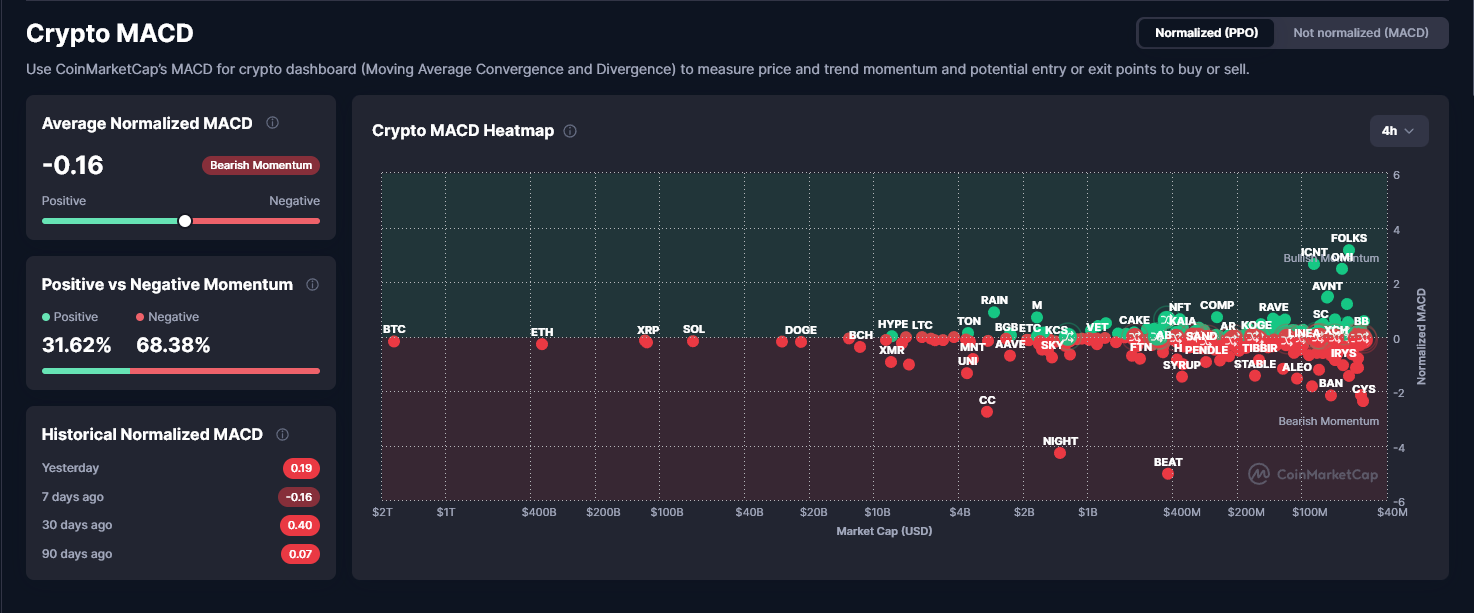 Average Crypto MACD. Source: CoinMarketCap
Why Altcoins Are More Exposed
Average Crypto MACD. Source: CoinMarketCap
Why Altcoins Are More Exposed
Altcoins rely heavily on cheap liquidity, retail inflows, and risk-on sentiment. Strong GDP growth combined with persistent inflation reduces all three.
With US consumers still spending but facing higher costs, disposable income for speculative investment may shrink in early 2026.
Institutions, meanwhile, remain cautious amid Bank of Japan risks and global rate uncertainty. That combination creates a difficult environment for altcoins to sustain rallies.
What This Means For Crypto Markets Going Into 2026The GDP report does not signal an immediate crypto crash. However, it raises the probability of prolonged consolidation or downside pressure, particularly outside Bitcoin.
If macro conditions remain unchanged:
- Bitcoin may continue to range rather than collapse.
- Altcoins could face extended drawdowns.
- Market leadership may narrow further.
Overall, strong US economic data is no longer bullish—it is a liquidity warning.
The post US GDP Surprise Signals Trouble for Altcoins, Not Bitcoin appeared first on BeInCrypto.