
What It Takes to Be Merchant-Ready for Agentic Commerce
The framing of agentic commerce as a future-only capability is increasingly an outdated one. At least, that’s becoming the case within the payments industry.
Findings in “How Acquirers Prepare for Agentic Commerce,” a new PYMNTS Intelligence report commissioned by Visa Acceptance Solutions, reveal that a growing share of acquirers now believe the foundational infrastructure for agentic commerce is already in place.
Nearly 80% of surveyed acquirers say they are at least somewhat prepared to support seamless omnichannel shopping experiences, a prerequisite for any system in which autonomous agents transact across digital and physical environments.
This could represent a notable shift. Payments modernization has historically lagged behind consumer-facing innovation, constrained by legacy systems and regulatory complexity. Yet the current moment suggests a reversal: the rails are largely built, and the conversation is now moving from capability to execution.
Why Agentic Commerce Will Arrive Once Merchants Close the Last-Mile GapIf the payment pipes are ready for agentic, then it follows that the pace of adoption may depend less on core technology and more on how quickly the broader ecosystem, and particularly merchants, can align with it.
But while acquirers express confidence in their own readiness, they see a much different picture on the merchant side. Only a minority of merchants are perceived as delivering truly consistent payment experiences across channels.
In practice, that means many businesses still operate fragmented systems where online and in-store transactions are not fully synchronized. For agentic commerce, which depends on seamless interoperability, those gaps represent a critical constraint.
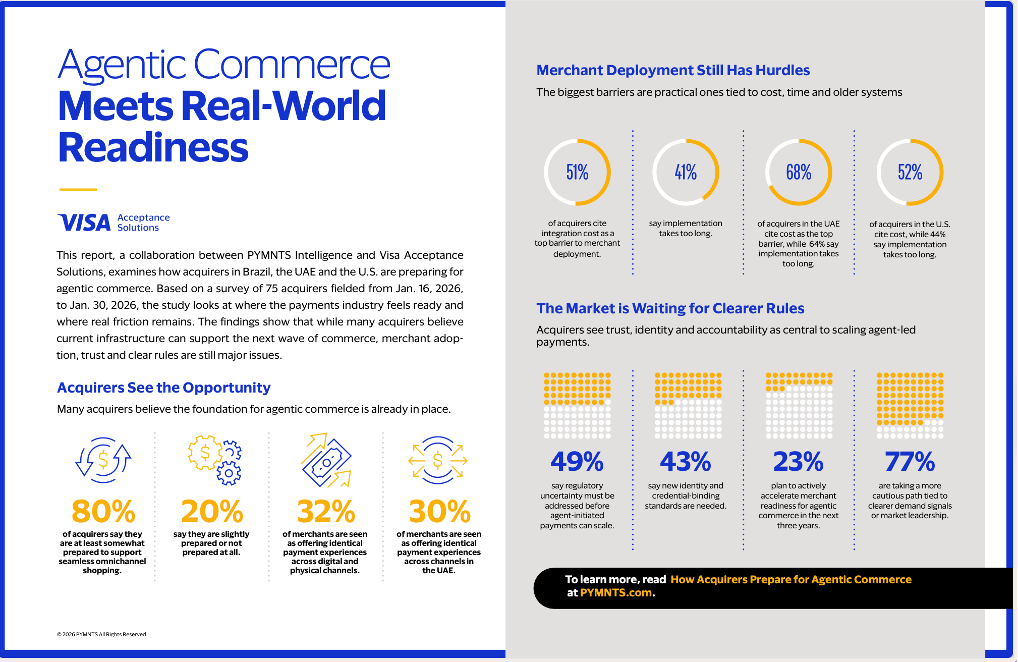
Integration cost stands out as a primary challenge for merchants, cited by more than half of acquirers as a top obstacle to merchant deployment. Implementation timelines are another persistent friction point, with many respondents noting that rolling out new payment capabilities simply takes too long.
Read the report: How Acquirers Prepare for Agentic Commerce
By distilling the report’s findings into four key operational priorities, a playbook for agentic readiness emerges for merchants.
- Unified omnichannel infrastructure
Merchants must deliver consistent payment experiences across digital and physical channels, closing the fragmentation gap that still exists for most. This may mean legacy platforms need to be upgraded or abstracted to support seamless integrations with acquirers, agents and third-party services. - Low-friction integration capability grounded in security
The ability to deploy new payment features quickly and cost-effectively is critical, given that integration cost and time are the top barriers today. At the same time, system-level support for secure credential binding and identity verification for agent-initiated transactions is becoming crucial. - Alignment with emerging standards and regulation
Faster implementation cycles and modular deployment models are required to keep pace with evolving payment capabilities. Merchants must be prepared to adapt to new rules governing trust, accountability and agent-led payments. - Partnership readiness can help drive full ecosystem forward
Close coordination with acquirers, payment service providers (PSPs) and platform providers will likely be essential to accelerate safe adoption of agentic capabilities.
The concept of “merchant readiness” can sound abstract, but in practice it is highly concrete. It is reflected in systems that talk to each other, in integrations that deploy quickly and in transactions that complete without friction.
The challenge, of course, is that most merchants are not building from scratch.
Legacy systems remain deeply embedded in the payments landscape, often tied to core business processes that are difficult to unwind. Replacing them outright is rarely feasible.
Instead, readiness is increasingly defined by the ability to modernize around them. This is where interoperability becomes critical. By layering modern application programming interfaces (APIs), middleware and orchestration platforms on top of existing systems, merchants can begin to participate in agentic commerce without a full-scale overhaul. The goal may not be perfection, but progress: creating enough connectivity to enable new capabilities while minimizing disruption to existing operations.
The payments industry has reached a point where readiness is no longer the primary constraint. The challenge and opportunity lies in bridging the gap between what systems can do and how widely those capabilities are adopted.
It may not arrive all at once. But step by step, transaction by transaction, a new model of commerce is taking hold, one in which the agents are ready, the rails are built and the market is finally beginning to catch up.
The post What It Takes to Be Merchant-Ready for Agentic Commerce appeared first on PYMNTS.com.