
Why Bitcoin Has Become an Element of Resistance in Iran’s Economic Crisis
According to Chainalysis, Bitcoin (BTC) has emerged as an “element of resistance” in Iran amid deepening unrest, with the overall crypto ecosystem surging to over $7.78 billion in 2025.
With the national currency under pressure and protests continuing across the country, cryptocurrencies have become a vital alternative for many Iranians, as evidenced by rising usage.
Iranians Increase Bitcoin Transfers as Economic Crisis DeepensBeInCrypto reported that since late December 2025, mass protests began sweeping Iran. The demonstrations erupted due to rising inflation and the sharp devaluation of the local currency against the dollar.
The US-based Human Rights Activists News Agency (HRANA) estimates that more than 2,500 people have been killed. The authorities have also shut down internet access.
Amid this unrest, Chainalysis observed a surge in crypto activity, with a higher average daily dollar amount transacted and more transfers to personal wallets.
Large withdrawals under $10,000 recorded the strongest growth, with the average dollar value withdrawn rising 236% and the number of transfers increasing 262%. Medium withdrawals under $1,000 climbed 228% in value and 123% in transfers.
Very large withdrawals under $100,000 also rose, with dollar amounts up 32% and transfers up 55%. Even small withdrawals under $100 increased, with average value up 111% and transfers up 78%. Furthermore, withdrawals from Iranian exchanges to unattributed personal Bitcoin wallets rose markedly.
“This behavior represents a rational response to the collapse of the Iranian rial, which has lost nearly all of its value, rendering it effectively worthless against major currencies like the euro,” the report read.
Bitcoin is up 2,653% in Iranian Rials because the currency is collapsing.
Iranians who held bitcoin preserved their wealth.
Iranians who trusted their currency lost 96%.
Everyone deserves money their government can't destroy. pic.twitter.com/wWlXVnGsGD
Chainalysis stressed that Bitcoin is serving a broader function during the crisis in Iran than just protecting value. The firm observed that for many Iranians, cryptocurrency has become an “element of resistance.”
Unlike conventional assets, which can be illiquid and vulnerable to state oversight, Bitcoin’s self-custody and resistance to censorship give individuals greater financial mobility.
This flexibility is especially critical in situations where people may need to leave the country or rely on financial systems beyond government control.
“This pattern of increased BTC withdrawals during times of heightened instability reflects a global trend we’ve observed in other regions experiencing war, economic turmoil, or government crackdowns,” Chainalysis wrote.
Iran’s Crypto Ecosystem Reaches $7.78 Billion in 2025The firm added that Iran’s crypto market grew sharply in 2025 compared with the year before, with the ecosystem exceeding $7.78 billion. Drawing on past patterns, Chainalysis said that crypto activity in the country surges during periods marked by major internal or geopolitical developments.
Notable jumps occurred during the Kerman bombings in January 2024, missile strikes against Israel in October 2024, and the 12-day war in June 2025, which included attacks on the nation’s largest crypto exchange and leading bank.
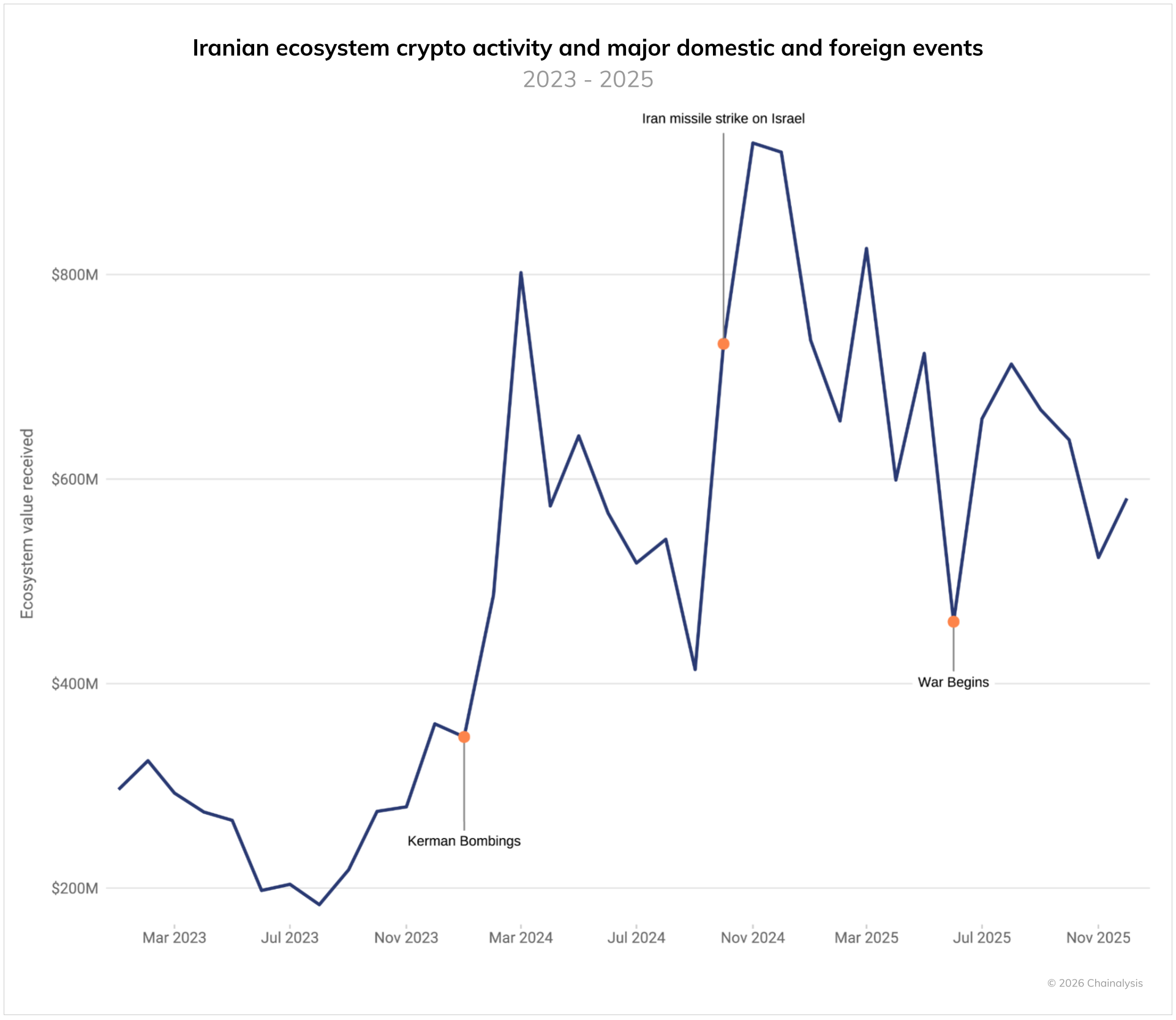 Iran’s Rising Crypto Activity Amid Major Events. Source: Chainalysis
The Islamic Revolutionary Guard Corps (IRGC) has become a dominant force in Iran’s cryptocurrency sector. IRGC-linked on-chain activity represented roughly half of the total crypto value received in Iran during Q4 2025.
The Chainalysis report estimates IRGC-linked wallets received more than $3 billion in 2025, up from over $2 billion the prior year. The group has increasingly relied on digital assets to bypass sanctions and support its regional financial networks. The team added that,
“We expect this figure will increase as more IRGC-affiliated wallets are publicly disclosed, and larger parts of their laundering network is exposed.”
Thus, it’s clear that cryptocurrency adoption in Iran has a dual nature. State-linked actors have leveraged digital assets to circumvent international sanctions.
At the same time, for ordinary citizens, it has become a way to protect savings from hyperinflation and the risk of asset seizure. Chainalysis suggested that cryptocurrencies are likely to remain a key tool for Iranians seeking greater financial autonomy.
The post Why Bitcoin Has Become an Element of Resistance in Iran’s Economic Crisis appeared first on BeInCrypto.